
The Current Aurora State Airport Master Plan Process
On December 29, 2025, the Oregon Department of Aviation (ODAV) issued a statement driven by the settlement of the Circuit Court case brought against them by City of Aurora. It read:
Developing the new Master Plan for the Aurora State Airport is a multi-year public process that has included 9 Planning Advisory Committee (PAC) meetings, 3 PAC work sessions, 2 open houses, and 1 public survey. With the PAC and public’s help developing the Draft Final Airport Master Plan in August 2025, the PAC process has concluded. However, the Oregon Department of Aviation’s coordination effort to support the Aurora Airport Master Plan is ongoing.
The Department intends to follow OAR 738-130-0055(6) and ORS 197.180(1) and bring the new master plan to the Board in 2026. This process will include a public hearing in Salem, Marion County, Oregon, with a public announcement at least 30 days prior to the hearing. The Board and the Department intend to comply with OAR 738-130-0055(6), which requires the Board vote whether to adopt the master plan and to make findings that the plan is compatible with the acknowledged comprehensive plans of affected cities and counties and that it complies with the applicable statewide land use goals. If the master plan is adopted, the Department and Federal Aviation Administration will then sign the Airport Layout Plan.
The Oregon Department of Aviation appreciates the PAC and public’s involvement and interest in the new Master Plan.
It’s striking that the department both said it would comply with the law and described how it would do so. It prompts the question why, and the answer is that this state agency was sued by a small city. The back story is a bit of a saga, which began with the initial formation of the Planning Advisory Committee in 2021. Of note, this was to be the “advisory” committee for a new master plan for the Aurora State Airport, and came a few years after the Oregon Court of Appeals ruled that the so-called 2012 Aurora Airport master plan was never lawfully approved and adopted by the Oregon Aviation Board (OAB), the oversight body with members appointed by the Governor, that has the statutory authority and responsibility to approve airport master plans.
Bad Process From The Beginning
At the first PAC meeting in November of 2021, the PAC was informed that “members were to serve as a representative for their organizations, and while their opinions would become part of the record, they would be a sounding board, would make no recommendations and might be asked for feedback:
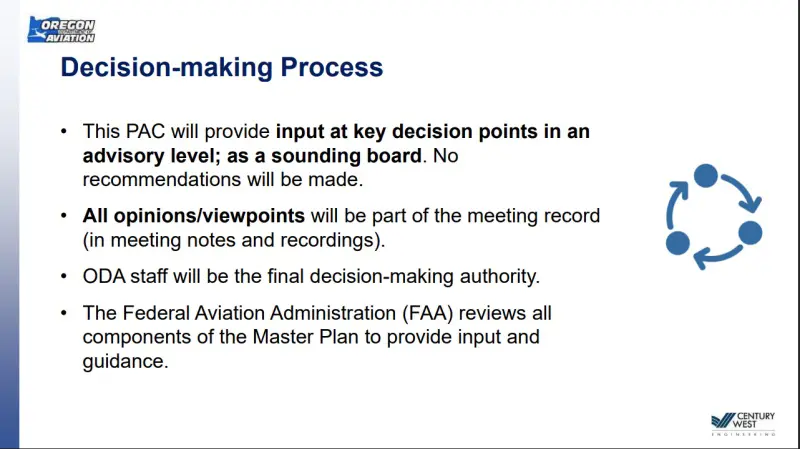
In other words, the Public ADVISORY Committee would by design not be giving advice or making recommendations! Rather, ODAV and its aviation consultant Century West would be making the decisions with concurrence from the FAA. The price tag on this master plan process was $1 Million paid by an FAA grant, and the process was intended to take eighteen months and conclude in 2023. The role ascribed to the PAC set the tone for a complicated a predetermined process clearly built around one major outcome: to expand the Aurora State Airport and lengthen the runway—which that ODAV failed to achieve with the so-called 2012 master plan.
It’s worth noting that the Mayors of Wilsonville and Aurora sent their first Joint letter to the Governor in December of 2021 expressing “profound disappointment” about ODAV’s handling of the master plan process and stating:
Our communities bear the brunt of impacts of the airport’s operations, and yet the Aviation Department appears to be discounting our concerns and is primarily responsive to vested financial interests at the airport.
The response from the Governor’s office? Silence.
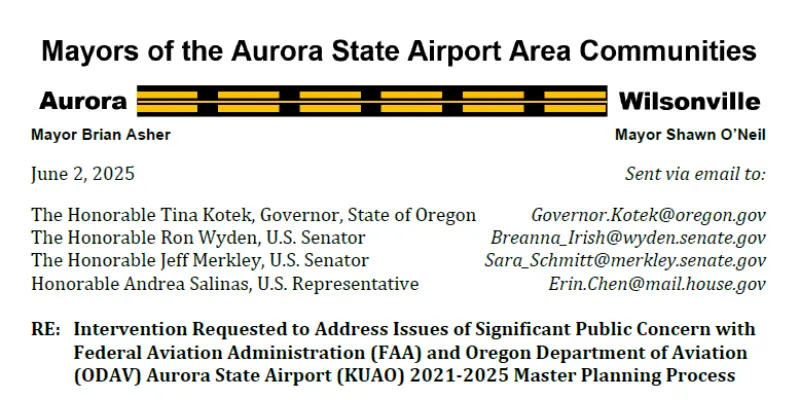
On June 2, 2025, the Mayors sent another Joint Letter to the Governor’s office, titled “Intervention Requested to Address Issues of Significant Public Concern with Federal Aviation Administration (FAA) and Oregon Department of Aviation (ODAV) Aurora State Airport (KUAO) 2021-2025 Master Planning Process. They detailed the public safety concerns at the airport, as well as the ongoing process problems with the master plan, and described the actions in 2011 where ODAV signed the Airport Layout Plan (ALP) apart from the master plan.
One of the parts of an airport master plan that the FAA is most concerned about (along with based aircraft and total operations forecasts) is the Airport Layout Plan (ALP), which is a detailed site plan. In late 2011 ODAV submitted the ALP that was part of the so-called 2012 master plan to the FAA. Some months later they received an approved and signed version from the FAA and immediately countersigned it. Then, having an approved ALP in hand, they never brought the master plan to OAB for approval and adoption. Only when a LUBA appeal was filed against them in 2019 did they quickly hold a Findings of Compatibility Hearing in Salem and then brought the results to an OAB at a meeting not held locally, but rather in Sun River!
The response from the Governor’s office about the second Joint Letter? Silence again! Thus, the trigger for the Circuit Court suit brought by City of Aurora: preventing a recurrence of an event that occurred back in 2011 during that master plan process and the unwillingness of the Governor to intervene in the situation.
Safety Problems and Delays
Why this matters is that it turns out you can operate an airport and be just fine (or at least pretty much okay) with the FAA if you have an approved ALP, even if you don’t have a master plan that has been approved and adopted consistent with state law.
That’s how the Aurora Airport has been operating for almost fifteen years, and during that time as the FAA’s safety standards have evolved, very little has happened to improve operations at Aurora outside of re-surfacing the runway. The workaround has been to seek Modifications of Standards (MOS) from the FAA. These are essentially variances from the FAA’s design standards. As the second Joint Mayor’s letter stated: “So many modifications of public-safety standards have occurred over the years that the FAA now demands improvement to these public-safety concerns by moving a state highway and greatly enlarging the Airport. The FAA has in effect threatened ODAV that failure to expand the Aurora State Airport will result in the Airport being placed in a “maintenance mode” and withdrawal of federal aviation funds.”
The master plan process was repeatedly delayed, and comprised nine PAC meetings, the last of which was in February of 2025. The delays were caused by reconciling expansion goals with the hard realities on the ground while simultaneously trying to get the Aurora Airport into compliance with the latest FAA safety standards. The safety standards problem includes things like not having adequate space between the runway and surrounding state and county roads, having little control over the mix of private and state property within the airport, having adjoining Through-The-Fence private developments with direct access to the airport, and no internal traffic circulating road, Aurora State Airport has long been high on the FAA safety violation list.
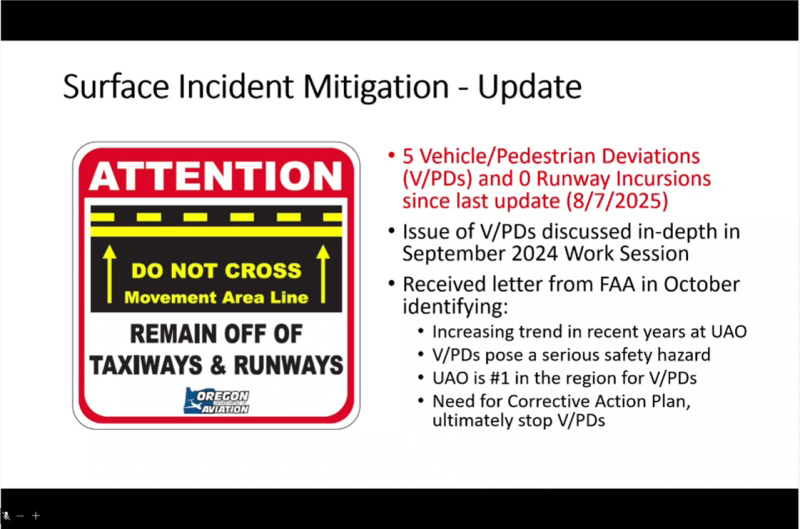
A measure of much of this is Vehicle/Pedestrian Deviations or V/PDs. This surface Incident Mitigation slide was presented to OAB at their December 2025 meeting, showing that the Aurora Airport was Number 1 in the region for V/PDs, and also Number 2 nationally!
Additionally, the FAA was taking a hard stance on correcting non-standard conditions and getting to acceptable design standards. The goal of trying to get to a master plan that achieved airport expansion and addressed the FAA’s safety requirements posed significant challenges for ODAV and their aviation engineering firm. Highlights of those challenges include:
- Counting aircraft based at Through-The-Fence properties as part of the Based Aircraft count. This is normally against FAA policy, but a waiver was granted.
- In spite of the delay that extended the PAC process by over two years, the refusal by ODAV and their aviation engineering firm to use the most current two years of operations data. 2016 through 2021 were used, and 2022 through 2024 were ignored though those years showed decreased annual operations.
- Selection of Design Aircraft based on oversized aircraft (technically too large for the length and strength of the existing runway) which resulted in a designation of a “larger class of aircraft” than the runway was designed for.
- Settling for only being able to “justify” a 500 foot runway extension because of land use challenge on the north and south ends, but proposing to move Highway 551 to the west to meet the FAA requirements for Runway Object Free and Safety Areas.
Alternatives scrapped
In spite of challenges made by some PAC members about the data used and conclusions drawn, when it came to defining and selecting the alternatives, leaving the airport as it is and only doing maintenance was dismissed out of hand. In June of 2024 ODAV organized a Master Plan Open House to present the alternatives and take public input. The event ran out of surveys for the public to complete! A total of eight alternatives were posted to the project website on June 11, 2024, and planned to be exhibited at the Open House. After additional consideration, the FAA determined that three alternatives were “not feasible” because they did not adequately address compliance with standards for current operations at the airport. These non-feasible alternatives were not presented at the June 13, 2024, event but remained posted to the website with an explanation of the change.
Overall, most respondents opposed key elements of the preliminary alternatives. A minority of participants were airport users, airport tenants, or local businesses who were supportive of the project.
- Property Acquisition: The majority of respondents were strongly against acquiring property for additional hangars and parking, including dozens of acres of high-value farmland, with only a small number strongly supportive, somewhat supportive or undecided.
- Runway Shifting: Most respondents felt that neither shifting the runway east nor west would work well. Some preferred shifting the runway east, shifting Hubbard Highway west, or were unsure or needed more information. Preliminary Alternatives Public Outreach Summary 5
- Runway Extension: A significant majority were strongly against extending the runway up to 497 feet, while a smaller group were strongly supportive.
- Runway Extension Direction: Most respondents felt that neither extending the runway north nor south would work well. While some preferred extending it south or north.
The process of refining alternatives continued, coming to a conclusion in October of 2024 when the Wilsonville Spokesman reported:
Amid continued dismay from local leaders and community members, the Oregon Department of Aviation is preparing to extend the Aurora Airport runway. Meanwhile, airport business representatives are concerned about impacts to nearby properties.
The department’s preferred option, announced at an advisory committee meeting on Tuesday, Oct. 15, would extend the runway by 497 feet — something long opposed by Wilsonville city officials and community members around the airport. Further, it would shift Hubbard Highway 80 feet to the west and require 43 acres of property acquisition. West of the highway, 13 residential properties and four commercial properties would be acquired and approximately 237,000 square feet of existing hangar space along the south portion would be removed to accommodate the construction of a taxilane parallel to the runway and a vehicle service road. This plan would be finalized once the airport master planning process is complete.
The department estimated the changes, including the shift of Hubbard Highway, would cost $185 million.
Of note, in addition to disenfranchising the PAC by informing it that it would not be providing advice, the Survey and Comments received from the public was a much larger set of data, the majority in opposition.
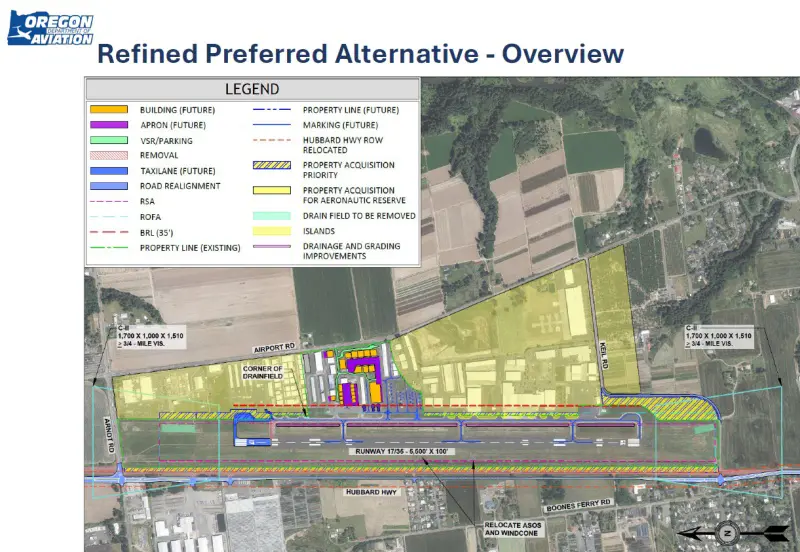
In spite of all this, the resulting master plan and ALP delivered the intended outcome: an expanded airport able to become Oregon’s largest commercial jet airport, notwithstanding the complexity to do so and the astronomical cost. Built into the methodology of this master plan was the purchase of private property both inside and outside the airport. Inside the airport doing so introduces “condemnation blight” in that ODAV identified both property needed to widen and lengthen the taxiway and run up area labeled as priority, but also other property labeled as aeronautical reserve. Outside the airport this condemnation acquisition includes EFU land west of the airport necessary to realign Hwy 551 and taking land from established businesses, as well as EFU land south of the airport to reroute Keil Road.
Another significant element is the “larger class of aircraft,” which appeared in a new way on the ALP, having to do with Runway Design Codes (RDC) – the codes used to describe the type and size of aircraft the airport is designed to handle.
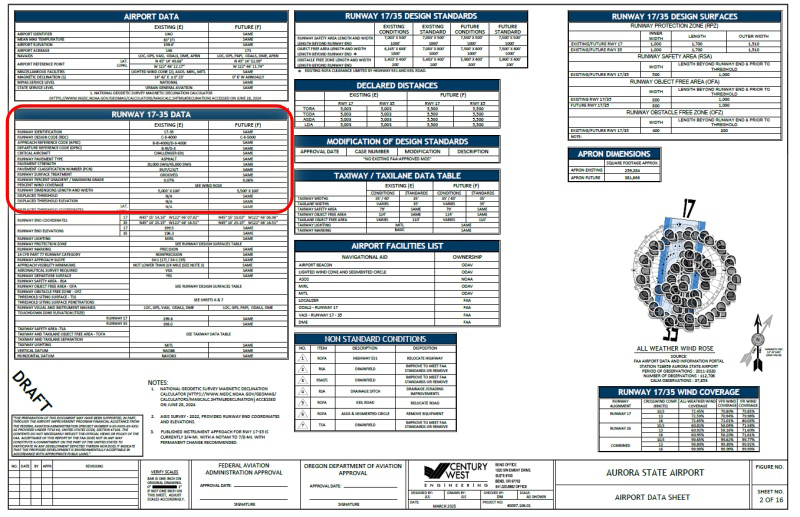
The 2011 ALP showed the airport RDC rating as C-II and future as also C-II, and the Design Aircraft was the Cessna Citation X. However, in the ALP sent to the FAA for approval and signature, the RDC rating had changed. The ALP delivered to the PAC on April 8, 2025, and then submitted to the FAA shows:
| Current | Future | |
|---|---|---|
| Runway Design Code | C-11-4000 | C-II-5000 |
| Approach Reference Code | Code B-III-4000/D-II | 4000 SAME |
| Departure Reference Code | Code B-III/D-II | SAME |
| Critical Aircraft | Challenger 601 | SAME |
In the PAC meetings the ARC was always shown as C-II. The PAC never saw an ARC rating that showed D-II for any part of it. This matters when you drop down a level and compare the specifications of the two aircraft.
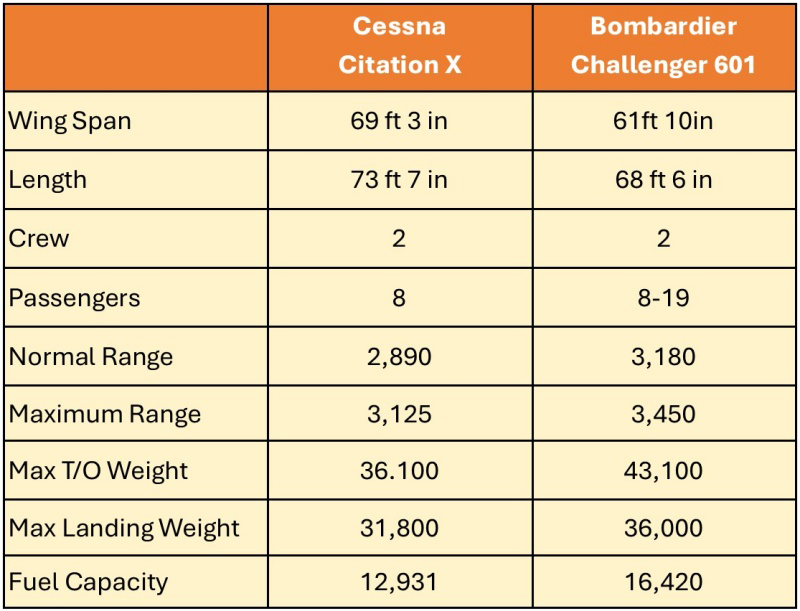
One doesn’t even need a calculator to see that the planned Design Aircraft is significantly larger, meaning more large corporate or privately owned jets. Worth noting is that less than 1 percent of the entire U.S. population has a pilot license, and it is estimated that there are about 16,000 private aircraft registered in North America. So, this is airport expansion primarily to benefit the wealthy. Beyond that is the fact no one wants to acknowledge: airports have impacts. Overflight noise, pollution rained down on nearby communities, hazardous substance runoff, traffic impacts, etc.
Approval and Adoption Process and the Circuit Court Suit
The significance of the City of Aurora circuit court suit increases when it becomes apparent that simply receiving an FAA-approved and signed ALP which is then countersigned by ODAV means the airport is suddenly officially rated for a larger class of aircraft. D-II is an ARC category for small commercial commuter jets as well as the largest private jets.
On Feb. 11, 2025, ODAV held the final PAC meeting where the project was summarized the timeline showed delivering the Final Draft Master Plan document to OAB in December, and the following slide (No. 29) was shown for Next Steps. Through Public Records Request we had already learned that ODAV had submitted the ALP to the FAA for approval and signature.
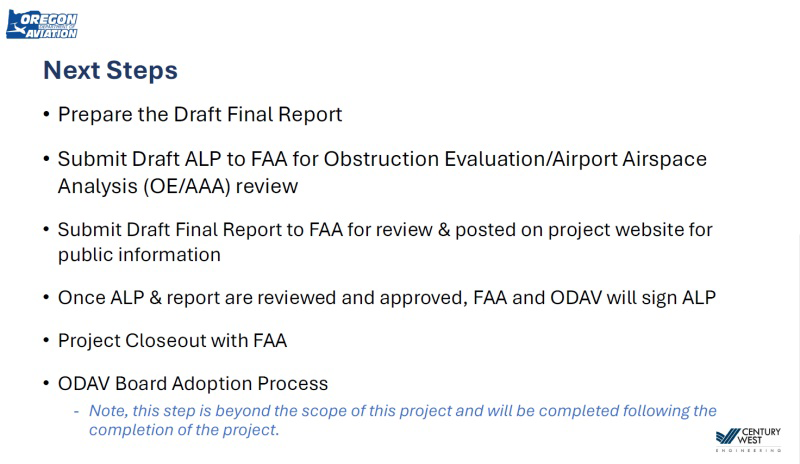
What is clearly detailed on the slide is that the ALP, which is part of the overall master plan document was to be separately submitted to the FAA in advance of the master plan. Further, only after the ALP was approved and signed by the FAA, and then received and countersigned by ODAV, would the master plan be submitted to OAB for approval and adoption.
Notice that in the list of next steps there is no mention of seeking Findings of Compatibility from the impacted jurisdictions (two counties and two cities) as required by OAR 738-130-0055, nor a public Compatibility Findings Hearing in advance of the OAB adoption process, also required by that rule. This slide is what triggered the Circuit Court suit by City of Aurora. The purpose was to prevent once again ODAV countersigning an ALP approved by the FAA and then dragging their feet on compatibility findings and OAB approval and adoption of the master plan.
While the Circuit Court suit proceeded and then moved to settlement discussions, ODAV did seek comments of compatibility from the impacted jurisdictions, the Cities of Wilsonville and Aurora and Marion and Clackamas counties. All four, with greater or lesser detail, said that the master plan was not compatible with their acknowledged comprehensive plan. The non-compatibility documents can be downloaded in PDF below.
- Download the Marion County Compatibility Comments
- Download the Clackamas County Compatibility Comments
- Download the City of Wilsonville Compatibility Comments
- Download the City of Aurora Compatibility Comments
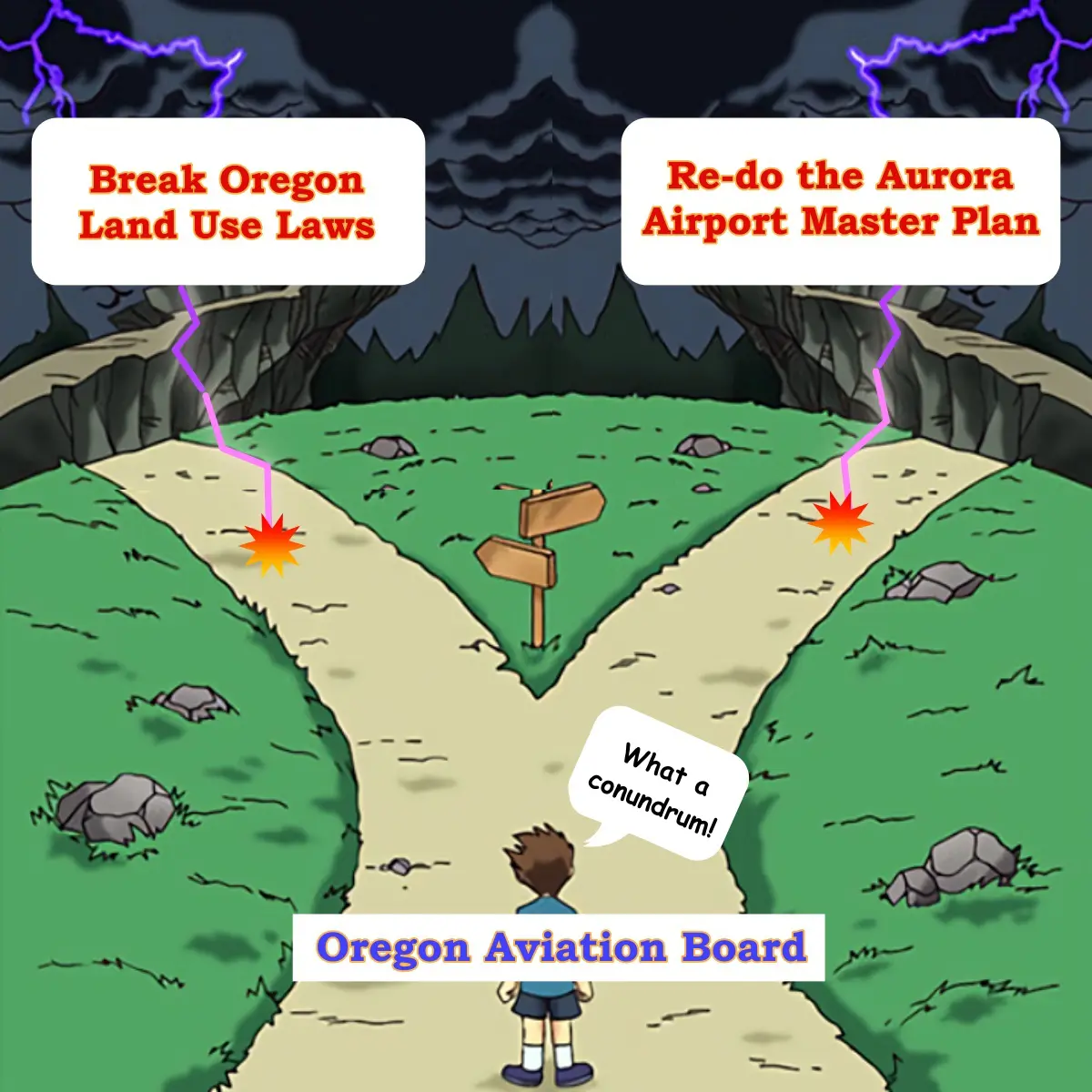
The simplest summary of the non-compatibility situation is if ODAV wants the master plan to be compatible, they have to change the master plan! That creates a “Oh, what a conundrum!” situation that looks something like this.
What’s ahead?
In the coming months ODAV is supposed to have meetings with the four impacted jurisdictions to discuss the non-compatibility and how to resolve the problems. Then a Compatibility Hearing will be scheduled from which a Findings of Compatibility document will be developed and presented to OAB for consideration to approve and adopt the master plan. That OAB decision will be the “land use decision” which several parties intend to appeal to LUBA. Remember last time, ODAV spent $295,000 to defend the 2012 master plan, only to lose at LUBA, the Court of Appeals, and the Supreme Court. And remember ODAV asked the 2025 legislature for $250,000 in legal fees for the new master plan, which the legislature smartly declined.
In the meantime, one might ask “What is wrong with the Final Aurora Airport Master Plan?” As we’ve seen, there was much wrong with the process, and there’s also much wrong with the plan itself.
Here are the seven biggest problems:
- Takes 15 acres of EFU land west of the airport by condemnation of private property to relocate Hwy 551;
- Condemnation of 9 acres of EFU land south of Keil Rd to expand the airport around the southern end of the runway;
- Introduces condemnation blight by identifying 150 acres of private property within the airport to acquire from “willing sellers,” plus 38 acres of EFU land to acquire to expand the airport south of Keil Rd;
- Fails to justify airport expansion by selectively using Total Operations forecast data and not acknowledging decreases in operations for 2022 thru 2024;
- Justifies lengthening the runway by 500 feet by selectively using data to identify Design Aircraft;
- Improperly changes the airport RAC rating from C-II to C-II/DI allowing service to larger aircraft;
- Inadequately addresses and seeks to circumvent Oregon’s land use system concerning requirements for urban development to be located in cities and the option to annex into the City of Aurora where the necessary water and sewer are available. Also inadequately addressed are: Stormwater management, Potable water, Septic capacity and infrastructure, transportation impacts on local roads, I-5 and the Boone Bridge, and urban development on rural land.